Artificial Intelligence (AI) is changing the way we interact with technology. Now, we have AI models like ChatGPT and Deepseek that are at the forefront of this new era.
Both of these models have a design that generates human-like text. However, they have distinct features, capabilities, and use cases.
In this blog post, Wayz Digitally will get into a detailed comparison of ChatGPT and Deepseek. We will discuss their strengths, weaknesses, and potential applications.
Overview of ChatGPT and Deepseek
ChatGPT
ChatGPT, developed by OpenAI, is a state-of-the-art language model based on the GPT (Generative Pre-trained Transformer) architecture. It generates human-like text based on the input it receives.
Similarly, ChatGPT’s training on a diverse range of internet text, allows it to produce responses across various topics. Users commonly use ChatGPT for applications such as customer support, social media videos, content creation, and personal assistants.
Deepseek
Deepseek, on the other hand, is a relatively newer entrant in the AI space. Deepseek aims to provide a more context-aware conversational experience.
Additionally, It has a design that understands user intent more accurately providing more relevant responses in the process.
Deepseek is often used in industries where precision is detrimental, such as healthcare, finance, and legal services.
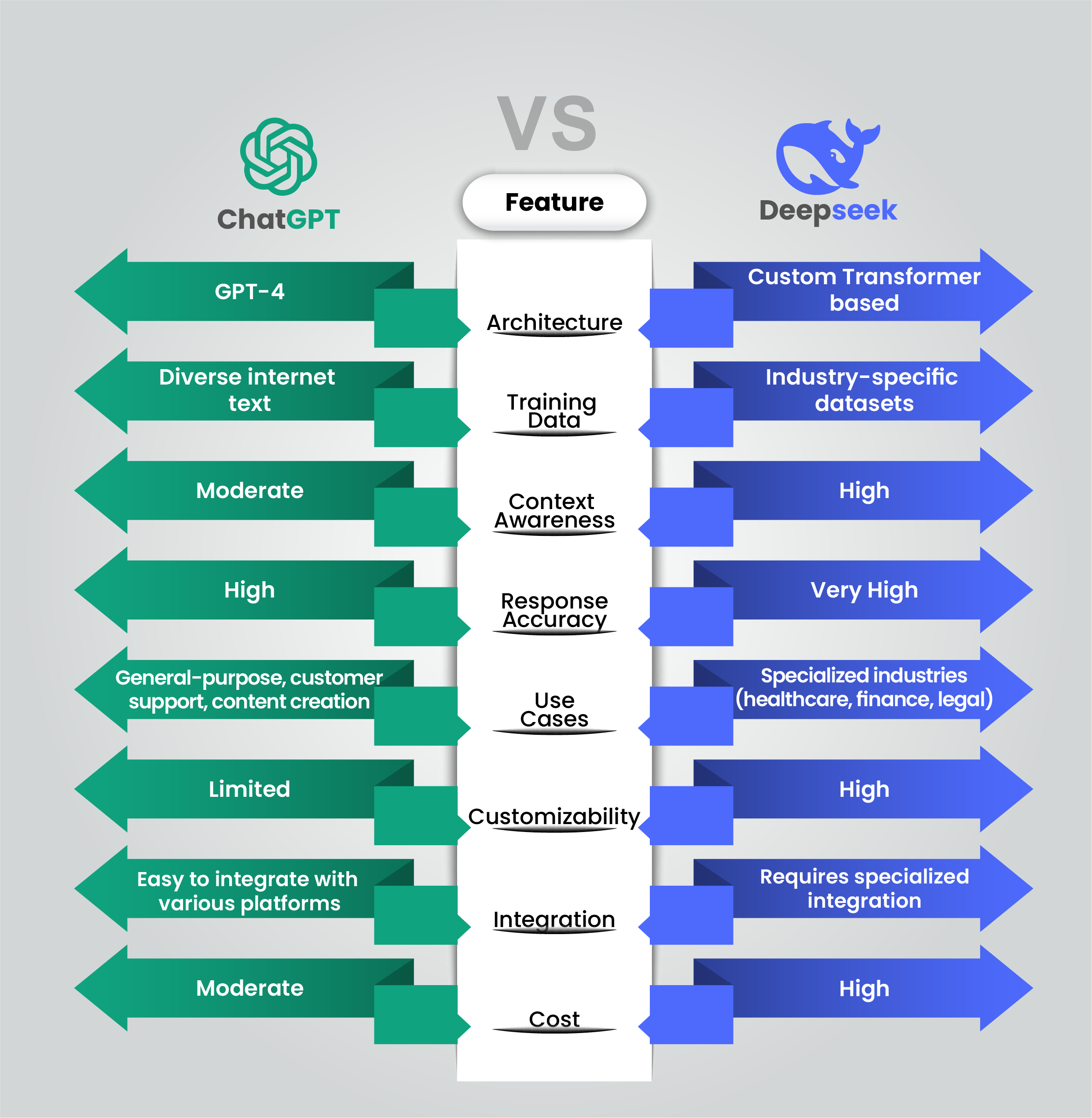
Feature Comparison Of Chat GPT And Deepseek
To better know the differences between ChatGPT and Deepseek, let’s compare their features.
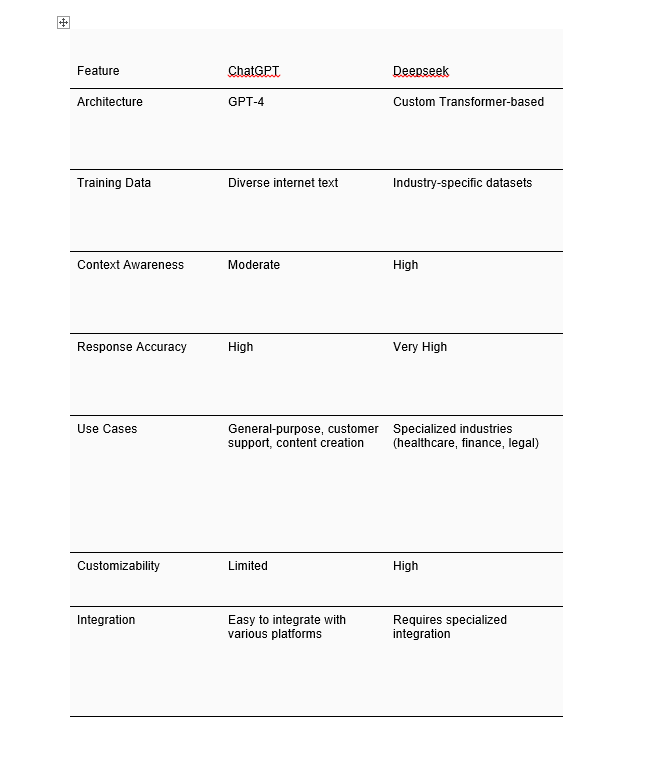
Feature | ChatGPT | Deepseek |
Architecture | GPT-4 | Custom Transformer-based |
Training Data | Diverse internet text | Industry-specific datasets |
Context Awareness | Moderate | High |
Response Accuracy | High | Very High |
Use Cases | General-purpose, customer support, content creation | Specialized industries (healthcare, finance, legal) |
Customizability | Limited | High |
Integration | Easy to integrate with various platforms | Requires specialized integration |
Cost | Moderate | High |
Performance Metrics
Let’s look at some performance metrics to compare ChatGPT and Deepseek.
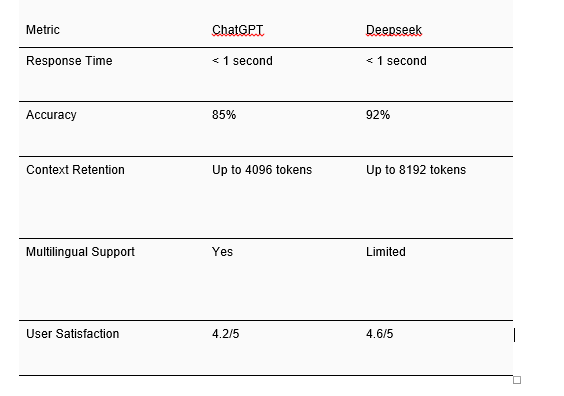
Metric | ChatGPT | Deepseek |
Response Time | < 1 second | < 1 second |
Accuracy | 85% | 92% |
Context Retention | Up to 4096 tokens | Up to 8192 tokens |
Multilingual Support | Yes | Limited |
User Satisfaction | 4.2/5 | 4.6/5 |
Response Time
Both ChatGPT and Deepseek have quick response times, typically under one second. This makes them suitable for real-time applications such as customer support and interactive chatbots.
Accuracy
Deepseek edges out ChatGPT in terms of accuracy, with a 92% accuracy rate compared to ChatGPT’s 85%. This is largely due to Deepseek’s special training on industry-specific datasets, which allows it to provide more relevant responses.
Context Retention
Deepseek also outperforms ChatGPT in context retention, with the ability to retain context up to 8192 tokens, compared to ChatGPT’s 4096 tokens.
This makes Deepseek better when it comes to complex conversations that require an in-depth know how of context.
Multilingual Support
ChatGPT has a clear advantage when it comes to multilingual support, offering capabilities in multiple languages. Deepseek, on the other hand, has limited multilingual support, focusing primarily on English and a few other major languages.
User Satisfaction
User satisfaction ratings are high for both models, but Deepseek’s specialized capabilities give it a slight edge, with a user satisfaction rating of 4.6/5 compared to ChatGPT’s 4.2/5.
Use Cases
ChatGPT
ChatGPT’s general-purpose nature makes it a better choice for a wide range of applications.
- Customer Support: ChatGPT can handle a variety of customer queries, providing quick responses.
- Content Creation: It can generate articles, blog posts, and other written content with minimal human intervention.
Personal Assistants: ChatGPT can be integrated into personal assistant applications to help users with tasks such as scheduling, reminders, and information retrieval.
Deepseek
Deepseek’s special capabilities make it suitable for industries who need precision at all costs.
- Healthcare: Deepseek can assist healthcare professionals by providing context-aware responses to medical queries.
- Finance: It can be used in financial services to provide information on market trends, investment opportunities, and regulatory compliance.
- Legal Services: Deepseek can assist legal professionals by generating legal documents and providing responses to legal queries.
Customizability and Integration
ChatGPT
ChatGPT is relatively easy to integrate with various platforms, making it a popular choice for businesses looking to implement conversational AI quickly.
However, its customizability is limited, which can be a drawback for organizations with specific needs.
Deepseek
Deepseek offers a high degree of customizability, allowing organizations to adjust the model according to their specific preference. However, this comes at the cost of more complex integration processes, which may require expertise.
Cost Considerations
Cost is an important factor when choosing between ChatGPT and Deepseek. ChatGPT is generally more affordable, making it accessible to a wider range of businesses.
Deepseek, with its higher accuracy, comes at a premium cost, which may be justified for some industries.
Conclusion
Both ChatGPT and Deepseek are powerful AI models, each with its own strengths and weaknesses.
ChatGPT’s general-purpose nature makes it a versatile choice for a wide range of applications. On the other hand, Deepseek’s high accuracy makes it ideal for industries where they need precision at all costs.